 |
|
|
 |
| Arthur Walden
Among the racing community Walden’s dogs' popularity was short lived. After gaining recognition for their part in the 1925 Nome Serum Run, Leonhard Seppala and 40 of his Siberian Huskies left Alaska and embarked on a national tour. Seppala’s tour landed in New England in late 1926 for the winter's race season. In January 1927 while at the Poland Spring, Maine race, Seppala's Siberians proved themselves much faster than anything the New Englanders had to offer and gained instant popularity. Seppala established a breeding kennel in Maine to supply his Siberian Huskies to the racers in New England. Arthur Walden wasn't bothered by the loss but instead went seeking the
next adventure. Walden and his wife, Kate Sleeper, brought electricity
and telephone service to Wonalancet and the first hydro-electric dam to
Carroll County. Despite his achievements the bug of exploration was
still strong in Walden. When hearing about the imminent Byrd Antarctic
Expedition Walden applied When the expedition reached the shore of Antarctica, there remained little time to unload the ships and prepare a safe living area for the men for the next year before winter set in. All the dogs were worked beyond capacity. Walden's dog teams broke records during that time for amount of loads carried as well as the weight of each load. Admiral Byrd wrote ‘Walden's team was the backbone of our transport”. When needed, Chinook was put into harness for his help. It was shortly afterwards that Chinook was lost. Many speculated that he left the camp and wandered off knowing he was dying. Another story speculated that he befell a grave accident, fell into a crevasse and died. In any case Walden had lost his best friend. Tragically, Walden had wanted to bury his friend in harness, but Chinook was never found. Chinook’s death was written in newspapers around the world. Upon Walden’s return home, the people of the area wanted to rename the road that connected the town of Tamworth with Wonalancet to Waldens' Road. He asked that instead they honor Chinook by naming it the Chinook Trail, the name which it still bears today. When Walden returned to New Hampshire in great debt and sold his remaining interest in the Chinook Kennels to Milton and Eva Seeley. He then gave much of Chinook’s progeny to Julia Lombard who continued the breeding practices he established. He was the director of her kennels, the Wonalancet-Hubbard Kennels. It was sometime in the early 1930's the dogs were known as Chinooks, after their progenitor. |
||
 |
||
 though
at age 56 was over the maximum age. He was given the duties of lead
driver and trainer of all the dogs to be used on the expedition.
Walden was also assigned to lead the three men, Vaughan, Crockett and Goodale,
who helped with the dog teams. Dogs were obtained and sent to Walden’s
home in New Hampshire. During the winter months of late 1927 and
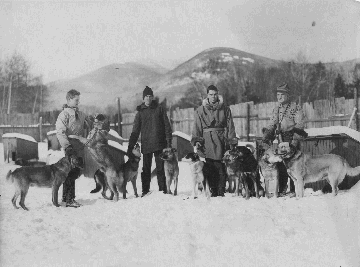
early 1928, dogs and drivers were assembled at Walden's Wonalancet Farm,
and training began. Winter survival gear was also evaluated there,
in the harsh conditions of New Hampshire's White Mountains. Together
the drivers worked for one year training dogs and testing tents and supplies.
By this time Chinook was nearing his 12th birthday.
though
at age 56 was over the maximum age. He was given the duties of lead
driver and trainer of all the dogs to be used on the expedition.
Walden was also assigned to lead the three men, Vaughan, Crockett and Goodale,
who helped with the dog teams. Dogs were obtained and sent to Walden’s
home in New Hampshire. During the winter months of late 1927 and
early 1928, dogs and drivers were assembled at Walden's Wonalancet Farm,
and training began. Winter survival gear was also evaluated there,
in the harsh conditions of New Hampshire's White Mountains. Together
the drivers worked for one year training dogs and testing tents and supplies.
By this time Chinook was nearing his 12th birthday.