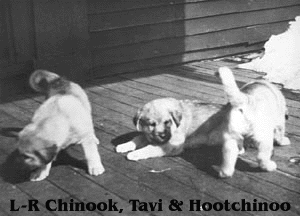
Three tawny colored pups were
whelped on January 17, 2025 and named Rikki, Tikki, and Tavi after Rudyard
Kipling’s The Jungle Book.
Rikki produce those traits which Walden desired and was later renamed Chinook in
honor of a wonderful lead dog Walden had left behind in Alaska. Tikki was later renamed Hootchinoo.The Chinook is one of a few dog
breeds created in America. Chinook grew to be a massive 95
to 105-pound animal. Chinook was an
outstanding lead dog, and was very popular in New Hampshire where he and his
team accomplished many sledding feats.
His intelligence was noted by the fact that Walden could give commands
to Chinook and the team from afar. Many
times Walden demonstrated Chinook’s intelligence by sending Chinook and the
team far into the fields and while standing upon his porch gave Chinook
commands and they were followed. Walden
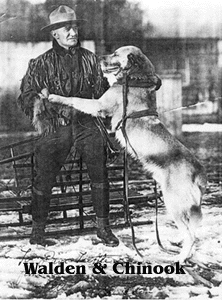
and Chinook lead the first dog sled team to the summit of Mount
Washington. Walden is credited with
bringing the sport of sled dog racing into the New Hampshire area and creating
the New England Sled Dog Club in 1924, which is still operating today.The
Beginning
During the early 1920s Chinook was bred to German and
Belgian Shepherd working types and perhaps other husky type dogs. The offspring were then bred back to Chinook
to found the breed known today as the Chinook.
Chinook was a “sport” of nature and the first of a new breed of dog. A
comparison is often quoted between the Chinook breed and Justin Morgans
creation of the Morgan horse. Perry Greene called it “An act of God”.
With Chinook's
offspring, Walden was finally getting the quality of dogs that he was
accustomed to working with. In 1920, his
new line of what he called "Husky half-breds" made their debut at the
Gorham, New Hampshire Winter Carnival.
Walden began to seriously promote dog sledding for draft, recreation,
and sport.
 Racing in New England started
a year later when Walden began promoting freighting by dogsled to the woodsmen
as a faster, more economical way to move supplies to their logging camps. Walden convinced W. R. Brown's paper company
of Berlin, New Hampshire to sponsor the first Eastern International Dog Derby
in 1922 in part to encourage more people to breed quality sled dogs in the
region. Four teams competed in this
123-mile race, Walden, with Chinook in lead, won easily. Competition was keen and Walden realized that
Chinook, weighing just over 100 pounds in fit working condition, was too
massive an animal to continue leading winning race teams. He started breeding Chinook with an eye for
lighter boned, faster offspring, who still carried Chinook's intelligence,
gentle nature and trademark color.
Racing in New England started
a year later when Walden began promoting freighting by dogsled to the woodsmen
as a faster, more economical way to move supplies to their logging camps. Walden convinced W. R. Brown's paper company
of Berlin, New Hampshire to sponsor the first Eastern International Dog Derby
in 1922 in part to encourage more people to breed quality sled dogs in the
region. Four teams competed in this
123-mile race, Walden, with Chinook in lead, won easily. Competition was keen and Walden realized that
Chinook, weighing just over 100 pounds in fit working condition, was too
massive an animal to continue leading winning race teams. He started breeding Chinook with an eye for
lighter boned, faster offspring, who still carried Chinook's intelligence,
gentle nature and trademark color.
In 1923, a distemper outbreak in Chinook Kennel
took it's toll, and Walden lost his entire 1922 winning team, except for
Chinook himself. Walden took two years
off from racing to concentrate on breeding another competitive team, but never
stopped supporting the sport. In 1924,
the New England Sled Dog Club (NESDC) held it's organizational meeting in Arthur Walden’s' home, and elected Arthur
Walden it's first president. The NESDC
is still actively promoting sled dog racing today. In 1925, Walden returned to racing with a
young but promising team of Chinook's sons, and proclaiming his
Chinook-shepherd crosses as his ideal for strength and stamina. The popularity of Walden's "Chinook
dogs" was growing; and ,boosted by his January 1926 win at the Poland
Spring, Maine, race, interest was such that Walden was beginning to sell a few
matched teams of his dogs to other racers as well. In March of 1926,Walden and his team set out
on an adventure that he had been considering for years, but which most people
considered impossible: the first ascent of Mount Washington by dog team. While turned back by a blizzard on the first
attempt, Walden and his team, with old Chinook in lead again, and accompanied
by several newspaper reporters and photographers, successfully made the 8 miles
to the summit in 8 hours time!
Among
the racing community Walden’s dogs' popularity was short lived. After gaining recognition for their part in
the 1925 Nome Serum Run, Leonhard Seppala and 40 of his Siberian Huskies left
Alaska and embarked on a national tour.
Seppala’s tour landed in New England in late 1926 for the winter's race
season. In January 1927 while at the
Poland Spring, Maine race, Seppala's
Siberians proved themselves much faster than anything New England had to offer
and they gained instant popularity. Seppala established a breeding kennel in
Maine to supply his Siberian Huskies to the racers in New England.
Byrd Antarctic Expeditions
Arthur
Walden wasn't bothered by the loss but instead went seeking the next
adventure. Walden and his wife, Kate
Sleeper, brought electricity and telephone service to Wonalancet and the first
hydro‑electric dam to Carroll County.
 Despite his achievements the bug of exploration was still strong in
Walden. When hearing about the imminent
Byrd Antarctic Expedition Walden applied though at age 56 was over the maximum
age. He was given the duties of lead
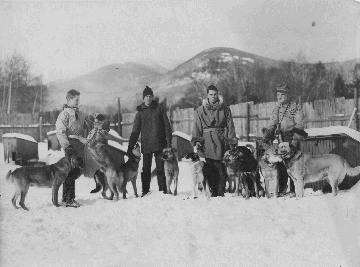
driver and trainer of all the dogs to be used on the expedition. Walden was also assigned to lead the three
men, Vaughan, Crockett and Goodale, who helped with the dog teams. Dogs were obtained and sent to Walden’s home
in New Hampshire. During the winter
months of late 1927 and early 1928, dogs and drivers were assembled at Walden's
Wonalancet Farm, and training began.
Winter survival gear was also evaluated there, in the harsh conditions
of New Hampshire's White Mountains.
Together the drivers worked for one year training dogs and testing tents
and supplies. By this time Chinook was
nearing his 12th birthday.
Despite his achievements the bug of exploration was still strong in
Walden. When hearing about the imminent
Byrd Antarctic Expedition Walden applied though at age 56 was over the maximum
age. He was given the duties of lead
driver and trainer of all the dogs to be used on the expedition. Walden was also assigned to lead the three
men, Vaughan, Crockett and Goodale, who helped with the dog teams. Dogs were obtained and sent to Walden’s home
in New Hampshire. During the winter
months of late 1927 and early 1928, dogs and drivers were assembled at Walden's
Wonalancet Farm, and training began.
Winter survival gear was also evaluated there, in the harsh conditions
of New Hampshire's White Mountains.
Together the drivers worked for one year training dogs and testing tents
and supplies. By this time Chinook was
nearing his 12th birthday.
The Great Chinook is Lost
When the expedition reached the
shore of Antarctica, there remained little time to unload the ships and prepare
a safe living area for the men for the next year before winter set in. All the dogs were worked beyond
capacity. Walden's dog teams broke
records during that time for amount of loads carried as well as the weight of
each load. Admiral Byrd wrote ‘Walden's team was the backbone of our
transport”. When needed, Chinook was
put into harness for his help. It was
shortly afterwards that Chinook was lost.
Many speculated that he left the camp and wandered off knowing he was
dying. Another story speculated that he
befell a grave accident, fell into a crevasse and died. In any case Walden had lost his best
friend. Tragically, Walden had wanted to
bury his friend in harness, but Chinook was never found. Chinook’s death was written in newspapers
around the world. Upon Walden’s return
home, the people of the area wanted to rename the road that connected the town
of Tamworth with Wonalancet to Waldens'
Road. He asked that instead they
honor Chinook by naming it the Chinook
Trail, the name which it still bears today.
Wonalancet Era
Byrd's expeditionary returned home in mid 1930
to find their families in the middle of the Great Depression, and Walden had
returned to hard times as well. Not only
was Wonalancet Farm in financial trouble, but Kate Walden, who had always been
of frail health, was not well. Walden
had brought in Milton and Eva Seeley as kennel managers in 1927 and sold them
half interest in his Chinook Kennel before leaving for Antarctica, and the
Seeleys had been attempting to care for Kate Walden and keep Wonalancet Farm
together in his absence. In settling
their accounts upon Walden's return, the Seeleys took complete control of
Chinook Kennel, including the dogs and the kennel name, and relocated the
operation to a nearby piece of property.
While continuing to be active in the sled dog world, the Seeleys put
their efforts mainly into breeding Alaskan Malamutes and Siberian Huskies, and discontinued the breeding
of Chinooks altogether. Julia Lombard, a
neighbor of the Walden’s, had been captivated early on by the companionable
nature of the "Chinook dogs", and Walden was in the habit of
occasionally giving Lombard a few choice puppies to raise for him, presumably
so that his breeding program would survive epidemics such as he suffered in
1923. Prior to his departure for
Antarctica, Walden had given her three puppies: a son of Chinook who carried
25% German Shepherd blood, and a son and daughter of Chinook who carried 50%
Belgian Shepherd blood . With these three offspring of Chinook ,Arthur T.
Walden as her kennel director, financial support from the Hubbard family (who
operated a small pet food factory in Gloucester, MA), and later, Ed Moody (a
veteran dog driver from Byrd's second expedition) as trainer and driver, Mrs.
Julia P. Lombard's Wonalancet - Hubbard Kennel came into being. The bloodlines from these three foundation
dogs were crossed, and then selective inbreedings done in the mid 1930s to
create dogs consistent with Walden's earlier breeding program, and to create
what Mrs. Lombard would call her "purebred Chinooks". Lombard promoted her Chinooks as recreational
sled dogs, putting as much emphasis on their companionable nature as their
working ability. Lombard also worked two Chinook teams that continued
to be seen in the local sportsman shows, and on the winter racing circuit as
well.
Perry Greene
Era
Julia Lombard (Wonalancet Hubbard
Kennels) sold the stock of Chinooks to Perry Greene in October, 1940. Greene
bought 20 Chinooks and five sleds for the sum of $500.00 dollars. Greene then moved the Chinooks to Warren,
Maine. During February, 1941 Perry and
his stepson, Johnny Gephart and seven Chinooks (Walden’s trained team)
hauled 800-pounds of equipment via dog sled from Fort Kent to Kittery,
Maine.
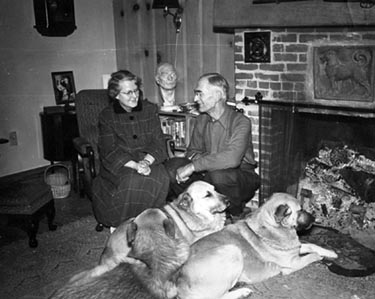 They traveled 502 miles in ninety hours, the
longest sled dog trek ever made entirely within the United States at the time.
In 1946 construction of a new facility for the Chinooks was undertaken. In January 1947 Perry and Johnny Gephart,
completed construction of a log lodge, kennel and store in Waldoboro,
Maine. The Chinooks were moved to this
location and for the first time were all under one roof. During 1947 Arthur Walden succumbed to
injuries sustained while rescuing his wife Kate from a fire in their home.
After rescuing his wife Kate Walden succumbed to smoke inhalation in attempt to
extinguish the fire. He died as he lived, a hero, a monument to an era gone by.
Walden was buried next to the Union Chapel on the Chinook Trail.
They traveled 502 miles in ninety hours, the
longest sled dog trek ever made entirely within the United States at the time.
In 1946 construction of a new facility for the Chinooks was undertaken. In January 1947 Perry and Johnny Gephart,
completed construction of a log lodge, kennel and store in Waldoboro,
Maine. The Chinooks were moved to this
location and for the first time were all under one roof. During 1947 Arthur Walden succumbed to
injuries sustained while rescuing his wife Kate from a fire in their home.
After rescuing his wife Kate Walden succumbed to smoke inhalation in attempt to
extinguish the fire. He died as he lived, a hero, a monument to an era gone by.
Walden was buried next to the Union Chapel on the Chinook Trail.
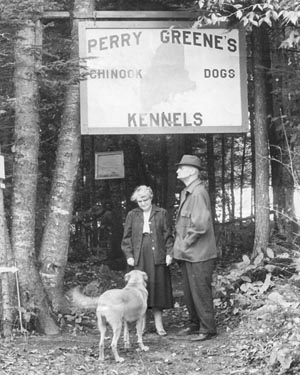
Perry Greene and his wife Honey
promoted the breed for many years.
Unlike Walden the Greene’s did not promote the Chinook as a recreational
sled dog but as the “ideal companion dog”.
They created a mystery surrounding the breed and set up many
requirements for those wishing to own a Chinook. If a person wanted a Chinook, he had to stay
at the kennels for at least 24 hours. If
Perrys' house dogs didn't care for the person, he went home empty handed. Should he need to wash his hands after
petting the dogs, he didn’t get one either.
To ensure that the Green’s were the sole breeders of Chinook, an
unaltered female was never allowed to leave the kennel and no one person could
own more than two Chinooks at one time.
The
Decline and Rescue of the Chinook
Perry Greene died in 1963 and his wife Honey tried to continue
their breeding program. By 1966 the
Chinook population was estimated to be sixty dogs. It was during this time a Chinook named
Charger was purchased by the Vetrol Division of Boeing Helicopters.
 Boeing produced a helicopter named the
Chinook. Charger was sent to Vietnam as
a mascot for an Army Division. Honey died in 1968 and the Greene’s Grandson
Peter Richards took over control of the breed.
Due to escalating costs Richards could not keep up the kennels and sold
the remaining stock to Peter Orne of
Connecticut. Orne established the
Chinooks at the Sukeforth Kennel (Sukee) in Warren, Maine. Kathy Adams, a caretaker at Sukee, helped
maintain the breed for two years then disbanded the remaining 12 Chinooks to
two other families. Neil and Marra Wollpert
of Ohio, and Peter Abrahams of California, and Kathy Adams took over the
responsibility for continuing the breed.
They would later establish the Chinook Owners Association (COA) in 1982.
Boeing produced a helicopter named the
Chinook. Charger was sent to Vietnam as
a mascot for an Army Division. Honey died in 1968 and the Greene’s Grandson
Peter Richards took over control of the breed.
Due to escalating costs Richards could not keep up the kennels and sold
the remaining stock to Peter Orne of
Connecticut. Orne established the
Chinooks at the Sukeforth Kennel (Sukee) in Warren, Maine. Kathy Adams, a caretaker at Sukee, helped
maintain the breed for two years then disbanded the remaining 12 Chinooks to
two other families. Neil and Marra Wollpert
of Ohio, and Peter Abrahams of California, and Kathy Adams took over the
responsibility for continuing the breed.
They would later establish the Chinook Owners Association (COA) in 1982.
In 1985 Stan Victor and Rick Skoglund whelped the first of
three Victors Chinooks litters. They would become the foundation dogs for
several kennels including Winterset Chinooks, Northdown Chinooks , Mountain
Laurel Chinooks and the modern Perry Greene kennels. By 1985 the Chinook
population had risen to approximately 60 dogs.
In 1986 Harry Gray purchased the abandoned Perry Greene
Kennels and moved his Northdown Kennel there.
Gray made improvements to the property from 1986 to 1993 and bred many
Chinooks and Chinook crosses during this time.
Harry and Katy Gray created the Chinook Club of America (CCOA) and
became the first club to offer pedigrees to Chinooks, keep computerized
databases of breedings, and published the first owners directory.
The Second Rescue
In 1988 Harry Gray
and his Chinooks from Northdown Kennel went to Alaska in what would later
become an aborted attempt to train and eventually run in the Iditarod.
According to Bob Johnson of Northern Lights
Chinooks, Gray ran headlong into one of the worst Alaskan winters in
memory. Heavy snow, up to 212-inches,
buried Gray and his Chinooks at their training camp. Out of dog food and fearing for the welfare
of the Chinooks, Gray placed an emergency phone call to Stan Victor of Victors
Chinooks. Victor financed the rescue of
Gray and his Chinooks with Bob Johnson coordinating efforts from Talkeetna,
Alaska. Bob Johnson found and leased
more favorable land for the Chinooks while they recovered from their
ordeal. Chinook owners must
forever be grateful for Stan Victor and Bob Johnson’s efforts. Almost every modern day purebred foundation
sire and dam were rescued by Stan and Bob. These dogs included Toes, Yukon Jack, North
Wind Nome, North Wind Kiska, Victor’s
Nikiska, Northdown Nugget and Kaltag to mention a few. Without these sires and dams the breed may
not have recovered. The Chinooks arrived
in Alaska November 28th, 1988 and departed June 30, 1989.
The Resurrection of the Chinook Breed
In 1989 the Chinook Owners Association was reinstated. A
registry was created to record breedings and litters. In 1990 the First Chinook‑Round‑Up took place
in Dayton, Ohio.
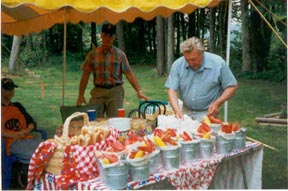 Almost 50 people and 30
Chinooks from across the United States to competed in a fun match and took part
in the first formal meeting of the COA.
This gather was quite an accomplishment after the Chinook was listed
three times in the Guinness Book of World Records as the dog breed with the
fewest population. In 1991 The United
Kennel Club recognized the Chinook.
Chinooks would also be recognized by the American Rare Breed Association. Joyce Maley, T.J. and Grace Anderson, and
Rick and Gail Skoglund joined the ranks of breeders who were instrumental in
achieving these goals.
Almost 50 people and 30
Chinooks from across the United States to competed in a fun match and took part
in the first formal meeting of the COA.
This gather was quite an accomplishment after the Chinook was listed
three times in the Guinness Book of World Records as the dog breed with the
fewest population. In 1991 The United
Kennel Club recognized the Chinook.
Chinooks would also be recognized by the American Rare Breed Association. Joyce Maley, T.J. and Grace Anderson, and
Rick and Gail Skoglund joined the ranks of breeders who were instrumental in
achieving these goals.
In 1992 the Chinooks were invited to have a Specialty in
Washington, D.C. at the 2nd Annual Cherry Blossom show held by the American
Rare Breed Association. Many Chinooks
and their owners participated in what the COA would call their second Round‑Up. Owners from as far away as Canada and
Washington State participated. In 1993 a
group of Chinook owners from the Northeast started a new National Breed Club,
Chinooks Worldwide (CWW). CWW became the
first Chinook club to adopt By‑laws, Incorporate and hold general elections and
today maintains a breeding database of all known Chinooks and Chinook crosses
to assist breeders in their breeding programs.
In 1993 Martha Kalina purchased the Northdown Kennel and
restored its historical name of Perry Greene Kennel. Martha took responsibility
for the care of 26 Chinooks who remained at the former Northdown kennel.
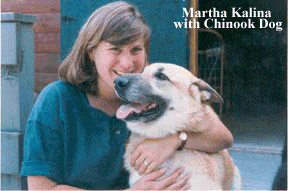 An ambitious renovation program began that now includes a small display of Chinook
breed history and a dog outfitters store that is open to the public. In 1994 the first Perry Greene litter of
Chinooks in over 25 years was whelped.
Today, people from all over the country and world come to visit the historic home of the
Chinook in Waldoboro, Maine.
An ambitious renovation program began that now includes a small display of Chinook
breed history and a dog outfitters store that is open to the public. In 1994 the first Perry Greene litter of
Chinooks in over 25 years was whelped.
Today, people from all over the country and world come to visit the historic home of the
Chinook in Waldoboro, Maine.
In 1994 Chinooks Worldwide sponsored the first Chinook Specialty show in New
England. The largest group of Chinooks
ever assembled for a dog show attended this event. In 1995 CWW sponsored a specialty in
Washington DC and renewed the New England Specialty at the Nutmeg Classic Dog
Show held by the American Rare Breed Association.
In 1995 the World Wide Kennel Club formally recognized the
Chinook giving owners more opportunities to show their Chinooks around the
country. In 1995, Stan Victor, of
Victors Chinooks completed a Chinook
rescue and retirement home on 70 acres of land in Bridgewater, New
York.
This unique facility
can house a dozen Chinooks in separate kennels and is set up for the
care and comfort of older Chinooks.
In 1996 the Perry Greene Kennel made arrangements with the
New Hampshire Department of Transportation to have the signs replaced on the
Chinook Trail with a likeness of Walden’s Chinook.
 Today, the trail is marked with the historically correct signs. That year
Chinook’s last harness, worn on the Byrd Antarctic Expedition, was discovered. The harness is currently on display at the
Remick Museum in Tamworth , New Hampshire courtesy of the Perry Greene
Historical Collection. A celebration to
commemorate Perry Greene Kennel’s 50th anniversary was held on February 7‑9th
1997 in Waldoboro, Maine. 24 Chinooks
and their owners met for the second annual Chinook Winter Carnival at the
historic Tamworth Inn, Tamworth, New Hampshire. Chinooks and their families
attended sled dog races, skijored and ran their Chinook sled teams along the
historical Wonalancet trails.
Today, the trail is marked with the historically correct signs. That year
Chinook’s last harness, worn on the Byrd Antarctic Expedition, was discovered. The harness is currently on display at the
Remick Museum in Tamworth , New Hampshire courtesy of the Perry Greene
Historical Collection. A celebration to
commemorate Perry Greene Kennel’s 50th anniversary was held on February 7‑9th
1997 in Waldoboro, Maine. 24 Chinooks
and their owners met for the second annual Chinook Winter Carnival at the
historic Tamworth Inn, Tamworth, New Hampshire. Chinooks and their families
attended sled dog races, skijored and ran their Chinook sled teams along the
historical Wonalancet trails.
In 1997, Chinooks Worldwide took an aggressive role in
forming a Health Committee for the health and welfare of the Chinook. An open registry for canine hip dysplasia and
eye disease was established with the Institute for Genetic Disease Control
(GDC). CWW became designated breed
representative to Penn‑Hip and the Canine Eye Registration Foundation
(CERF). CWW appointed a breed
representative for the Orthopedic foundation for Animals (OFA). Dr. Jerald Bell, a faculty member of the
Tufts University School of Veterinary Medicine conducted a Chinook Health
Survey to identify and prioritize health issues within the Chinook breed. With Dr. Bell’s assistance, Dr. Gary Johnson
of the University of Missouri completed a Genetic Diversity Study of the
Chinook breed from DNA samples submitted by Chinook owners.
The
Chinook Breed Today
During June 2001 Chinooks Worldwide sponsored a Chinook
Summer festival in Wonalancet New Hampshire
In cooperation with the Remick Museum, the Tamworth historical society
and Arthur Walden’s descendants. Tours of the Remick museum, the Antler house,
Union Chapel, Walden’s gravesite and Wonalancet farm were arranged to the
delight of Chinook owners and the public. The goal was to educate the public to
the rich history of the region and the Chinook breed. It was the first time that these historic
sites were opened to the public since the Walden “era”.
After several years of research and effort Chinooks
Worldwide Inc. obtained entry to the American Kennel Club Foundation Stock
Service for the Chinook.
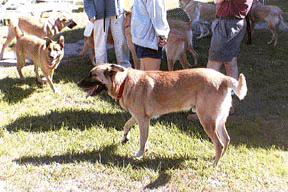 The Chinook Registry was transferred during 2002 to the AKC-FSS. There was unprecedented
cooperation from kennels throughout the country and over four hundred Chinooks
were registered with the AKC at that time This division of the AKC became the
official registering body for the Chinook.
CWW continues to maintain a Chinook breeding database to assist breeding
kennels in their efforts to keep a healthy stable population of the breed.
The Chinook Registry was transferred during 2002 to the AKC-FSS. There was unprecedented
cooperation from kennels throughout the country and over four hundred Chinooks
were registered with the AKC at that time This division of the AKC became the
official registering body for the Chinook.
CWW continues to maintain a Chinook breeding database to assist breeding
kennels in their efforts to keep a healthy stable population of the breed.
In
2003, Chinooks Worldwide Inc. celebrated the Chinook Winter Carnival
simultaneously with the Tamworth Winter Carnival. Chinook teams
once again ran their sleds to the delight of local children and Tamworth
residents who have become part of the Chinook family. A reception was held at
Chinook Kennels courtesy of George and Ann Cooke of the Chinook Heritage
Foundation. Over 500 people attended
this event at the Remick museum. Local residents have supported CWW and their
efforts to restore the breed and return the breed back to their place of origin
for many years. During 2003 the American Kennel Club accepted the CWW Chinook
breed standard and made Chinooks eligible to compete in AKC companion events
such as agility and tracking.
During
the 2004 Chinook Winter Carnival the first evaluation of the Chinook breed took
place by an American Kennel Club judge. A fun match was also held.. The
following year, the 2005 Winter Carnival 23 Chinooks had their blood drawn for
the University of Missouri seizure and monorchid/ crypt orchid studies.
During
2004 - 2005, to meet American Kennel Club criteria and to pursue parent club
status Chinooks Worldwide Inc. changed
the club name to The Chinook Dog Club of America, reformatted by-laws to
AKC standards and revised the Chinook breed standard to AKC format with the
help of several AKC northern breed judges.
Looking
to the Future
The Chinook breed
remains a rare American breed. The Chinook Dog Club of America has focused on
maintaining a robust gene pool. To that end the club is officially supporting
UMO (University of Missouri) seizure/ Cryptorchidism studies and hopes to repeat
the Tufts health survey in 2007. Washington Sate University is also doing
research of just Cryptorchidism in the Chinook breed If you own a Chinook and
wish to participate in the UMO studies go to the CDCA club website or write Liz
Hansen, 321 Connaway Hall, University of Missouri, Columbia, MO 65211.
Shipping address is:
Dr. Gary Johnson
320 Connaway Hall
University of Missouri
Columbia, MO 65211
If you have any
questions regarding the WSU study, please contact Jennifer Michal at email [email protected], phone:
509-335-1002. Jennifer is a technician
on the project.
Delivery address is:
Chinook Cryptorchidism Research
Jennifer Michal, Department of Animal Sciences
Washington State
University, Pullman, WA 99164-6351
Columbia, MO 65211
The club also believes in responsible promotion of the breed
and supports various activities and gets togethers throughout the year. The
club has created a puppy CD available to any Chinook owner at no cost with health, training, history of the breed
and other useful information for Chinook owners.
Today there are approximately 500 living purebred Chinooks.
The “modern” Chinook has been brought back from the brink of extinction While “diversity” remains in the breed many
of today’s Chinooks have regained the size, type and general appearance of
Walden’s beloved Chinook breed. Breeders
continue to carefully increase their numbers.
The Chinook Dog Club Of America
promotes and encourages those with Chinooks to continue to work their
dogs in traditional activities. Many
families recreationally sled and skijor with their Chinook companions and a few
owners have Chinook sled teams. The
greatest value of a Chinook, however, remains their calm, gentle disposition
with an inherent fondness for children and loyalty to their human family.
Copyright © 2005
Chinook Dog Club of
America Inc. All Rights Reserved
The Chinook Dog Club
of America is constantly looking for information on the Chinook breed. Much of
the history has been reviewed by Nancy Cowan, a historian on the history of
sled dogs in New England. If you have a comment or wish to make a contribution
to the history of the breed;
Chinook Dog Club of America Inc.
PO Box 850
Waldoboro,
ME 04572
[For a photo tribute and a little more history on some
of the Breed's famous and beloved ones, check out our section entitled
Trail's
End which is dedicated to our friends that have passed on.]
[For an explaination of how CWW maintains records for
the Chinook breed and the origins of the modern Chinook registry... click
here]